
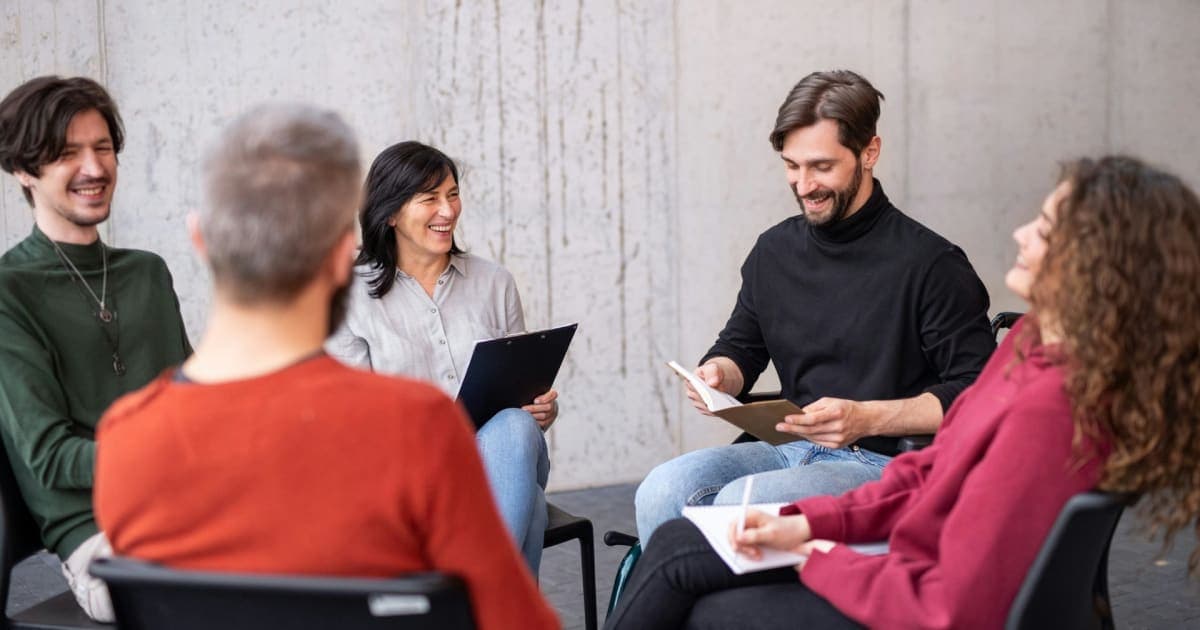
What is Group Coaching?
Quick Excerpt: Discover what group coaching is, how it differs from one-on-one and team coaching, and how The Circle uses Guided Cognitive Activations™ to turn reflection, peer conversation, and coaching into a repeatable growth practice.
Meta Description: What is group coaching? Learn how it works, why it helps, and how The Circle uses Guided Cognitive Activations™ for growth.
Image: https://drive.google.com/file/d/1vqd8WIPob6hCsG8cpSavr2t_1CCdCRKs/view?usp=drive_link
Category: Coaching
Blog:
Most people don’t struggle because they lack information.
They struggle because they don’t have the structure to think clearly.
They have ideas, but no space to process them.
They have goals, but no consistent environment to reflect, question, and act.
This is where group coaching enters.
Over the past decade, group coaching has emerged as one of the most powerful and scalable approaches to personal and professional development. But despite its rapid growth, one question remains surprisingly unclear:
What is group coaching, really?
The Rise of Group Coaching
Group coaching is not just a trend. It is a response to a deeper shift in how people learn and grow.
Traditional development models focused on:
- Information (courses, books, seminars)
- Individual support (one-on-one coaching)
But increasingly, research and practice show that growth happens most effectively when three elements come together:
- Reflection
- Interaction
- Application
Group coaching brings all three into a single environment.
In fact, research suggests that group coaching is particularly effective at promoting collective thinking and shared understanding, making it a powerful complement to individual coaching.
It is also inherently scalable, allowing more people to access structured development at the same time.
A Clear Definition of Group Coaching
At its core, group coaching can be defined as:
- A structured developmental process where a coach facilitates reflection, conversation, and action among multiple individuals working on their own growth within a shared environment.
This definition matters because group coaching is often confused with similar approaches.
Group Coaching vs One-on-One Coaching
One-on-one coaching focuses entirely on one individual’s thinking, decisions, and actions.
Group coaching introduces something new:
multiple perspectives
Participants gain insight not only from their own reflection, but from hearing how others think about similar challenges.
Group Coaching vs Team Coaching
This distinction is critical.
- Team coaching focuses on improving the performance of a team working toward a shared goal.
- Group coaching focuses on individual growth within a group setting.
In group coaching, participants may share themes or interests, but they are not necessarily working toward the same outcome.
Research supports this distinction, noting that group coaching brings together individuals pursuing their own goals within a shared learning environment.
Why the “Format” Question Misses the Point
One of the most common questions people ask is:
How many formats of group coaching are there?
The assumption behind this question is that group coaching is divided into clearly defined models.
But the research tells a different story.
There is no universally accepted taxonomy of group coaching formats.
Instead, most studies describe group coaching in terms of core processes, not fixed structures.
These processes include:
- Reflection
- Dialogue
- Feedback
- Perspective-taking
- Action
In other words:
Group coaching is not defined by its format. It is defined by how people think, interact, and change inside the experience.
The Five Common Patterns in Group Coaching
Although there is no rigid classification system, both research and practice point to five recurring patterns.
1. Teaching-Led Group Coaching
The coach introduces a concept, framework, or model.
Participants then discuss and apply it.
This approach is useful when introducing new ways of thinking.
2. Discussion-Led Group Coaching
The session centers around a question or theme.
Participants explore it together.
Insight emerges from the interaction itself.
3. Peer Coaching
Participants coach each other using structured questions.
This builds awareness, listening skills, and ownership.
4. Hot-Seat Coaching
One participant is coached while others observe.
Observation becomes a powerful learning tool.
Participants often recognize their own patterns through someone else’s situation.
5. Action and Accountability Sessions
The focus shifts toward:
Decisions
Commitments
Follow-through
These sessions ensure that insight leads to action.
In reality, most effective group coaching experiences combine several of these patterns.